If you post consistently and your follower count barely moves, you're probably not doing anything wrong as a person. You're just missing a few specific things.
This guide is based on how we grew our own account, plus patterns we've seen across hundreds of Xpilot users who went from posting into the void to actually unlocking X's Creator Revenue Sharing program.
Here's what's in it: how to set up your profile so it actually converts, how to use replies to grow before your own posts have reach, what's actually working in 2026, and a few small tricks for extra reach.
Step 1: Make your profile actually convert
Before anything else, it helps to know why people follow accounts at all. People follow you for one of four reasons:
- They relate to you. Your story or your day to day feels familiar.
- They learn from you. You save them time or teach them something new.
- They're entertained by you. You're funny or fun to watch.
- They're intrigued by you. You make them think, or say something in a way they haven't heard before.
Most accounts that grow lean on one or two of these, not all four at once. Figure out which one is actually you before you optimize anything else.
Every tactic in this guide sends strangers to your profile. If the profile doesn't turn that visit into a follow, none of it matters.
Bio. Tell people what they'll get from following you, in a way that matches at least one of the reasons above. Then add a quick fact that proves you know your stuff. A couple of real examples, with why they work:
- @thejustinwelsh: "Writer & Entrepreneur. I write The Saturday Essay for 200,000+ ambitious people living and working on their own terms." The 200,000+ is social proof, "Saturday" sets a cadence you can expect, and the last part is the actual promise, not a job title.
- @fin465 (Finn Mallery, founder of Origami): "Founder @origamichat, sharing b2b growth hacks daily. Studied AI @Stanford." Who he is, what he posts about, how often, and a credibility marker, all in one line.
Neither of these is a résumé. They're a promise.
Pinned post. This should be your best result or your best hook, not just whatever you posted most recently.
Avatar and banner. A real photo works better than a logo for personal accounts. People follow people. Use the banner to back up your bio: a result, a quote, an add, or something that matches what you're known for.
Step 2: Become a reply guy before you're a poster
Early on, your own posts barely get seen. You don't have an audience yet to show them to. Replies use someone else's audience instead.
So flip your attention: reply a lot, post less, until your own posts start getting real numbers. As you grow, that ratio flips back.
The catch is that lazy replies don't work. "This." "So true." A single 🔥 emoji. These add nothing, and X quietly buries them because they look like engagement farming. A good reply adds something the original post didn't already say: a counterpoint, an example, a number, a related story.
Two things make this easier to keep up:
- Make a private list of the top accounts in your niche, and reply from that list instead of your normal feed. It's a much denser stream of good posts to jump into than scrolling and hoping something shows up.
- Turn on notifications for 2 to 3 of the biggest accounts in your space. An early reply gets seen by way more people than being reply number 80 an hour later.
Step 3: Post with a purpose, and check what's working
You still need to post. Replies alone won't get people to follow you specifically. But posting the same format on repeat, even after it stopped working, is how accounts stall without noticing.
Xpilot has post analytics built for exactly this: see which of your recent posts actually got reach and which ones didn't, instead of guessing.
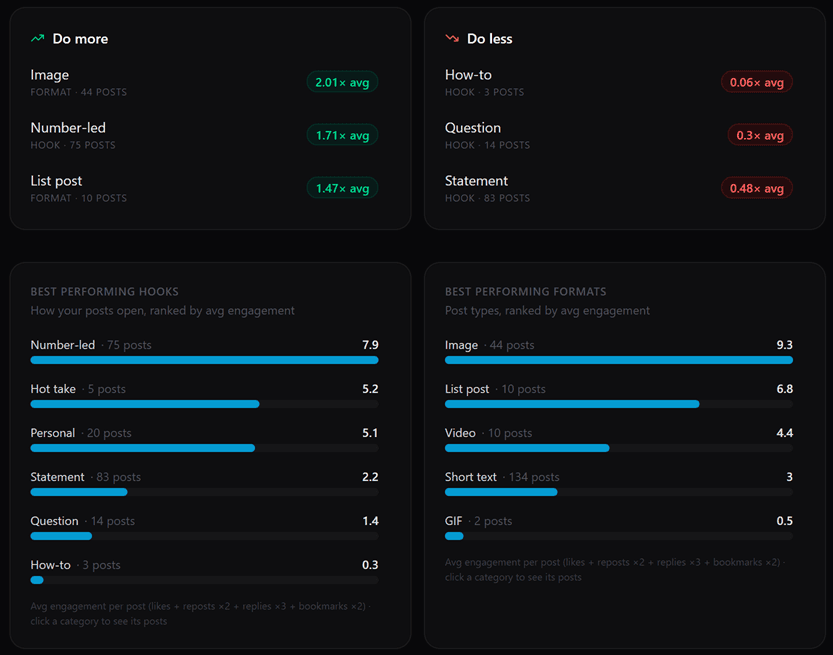
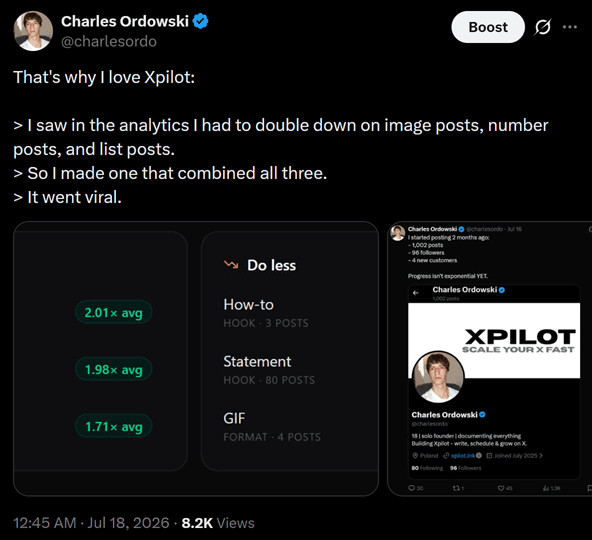
After applying what Xpilot's analytics showed was actually working, posts using those formats started performing noticeably better:
Hooks and formats that work in 2026
A few patterns keep showing up in posts that travel further than average:
- Curiosity gap. Say enough to raise a question, not enough to answer it.
- A specific number. "7 mistakes" sounds more credible than "some mistakes."
- A clear opinion. Say something a reasonable person could disagree with, and mean it.
- Social proof up front. "I looked at 200 of my own posts" carries more weight than "here's some advice."
Format matters too. Plain text still works, but video and other native formats get more reach for the same effort in 2026. The algorithm favors formats that keep people watching or scrolling longer.
The 2026 crackdown on copy-paste content
X got a lot better at detecting copy-pasted content. Posting something like this doesn't work anymore, and can get you banned:
Hey @X algorithm 👋
I'm looking to connect with people interested in:
SaaS, Frontend, Backend, Full-stack, DevOps, App Development, AI / ML, Data Science,
If that's you, let's connect
X is full of founders
Reddit is full of opinions
LinkedIn is full of …
You will often see these types of posts where everyone is copying each other. Don't give in to the temptation to do the same.
Build an actual content mix
- Personal. Your story, behind the scenes, what you got wrong.
- Expertise. How-tos, frameworks, how something actually works.
- Proof. Results, before and afters, real numbers.
- Opinion. A stance people can agree or disagree with.
Early on, lean on the first two. You haven't earned the right to post wide opinions yet if nobody knows who you are. As you grow, opinion and proof can take up more space. Posting broad life advice on day one, before anyone has a reason to care what you think, is one of the most common reasons small accounts stall.
Common mistakes that quietly kill growth
- Chasing one viral post instead of running a system. One good post is luck. A hundred posts built the same way is a strategy.
- Going wide too early. Generic advice from an account with no track record gets ignored.
- Ignoring replies once you're bigger. Accounts that keep growing usually keep replying long after they don't strictly need to.
- Never looking back at what worked. If you can't say which of your last 10 posts did well and why, you're not really improving, just producing.
A few tricks for extra reach
- Post when your audience is actually online, not at some generic "best time." Your own history is more accurate than any chart.
- Repost your own post a few hours later. It puts it back in front of people who missed it the first time.
- Hold the link. If a post is meant to drive clicks, don't add the link right away. Post it as a comment once the post is already getting traction. A clean post without a link usually gets shown to more people first.
Put this into practice with Xpilot
Write, schedule and auto-repost your posts at your best times, without the guesswork or the manual work.
Recap
Fix your profile first, since every other tactic sends people to it. Spend most of your early attention replying, not posting, and make sure the replies actually add something. Post consistently, but check what's working instead of repeating a format that stopped landing, and lean into 2026's shift toward video and native formats. Avoid going wide before you've earned an audience that cares what you think. And once the content is right, a few small habits add real reach on top of everything else: posting at your real best times, reposting after a few hours, and holding the link until the post is already moving.